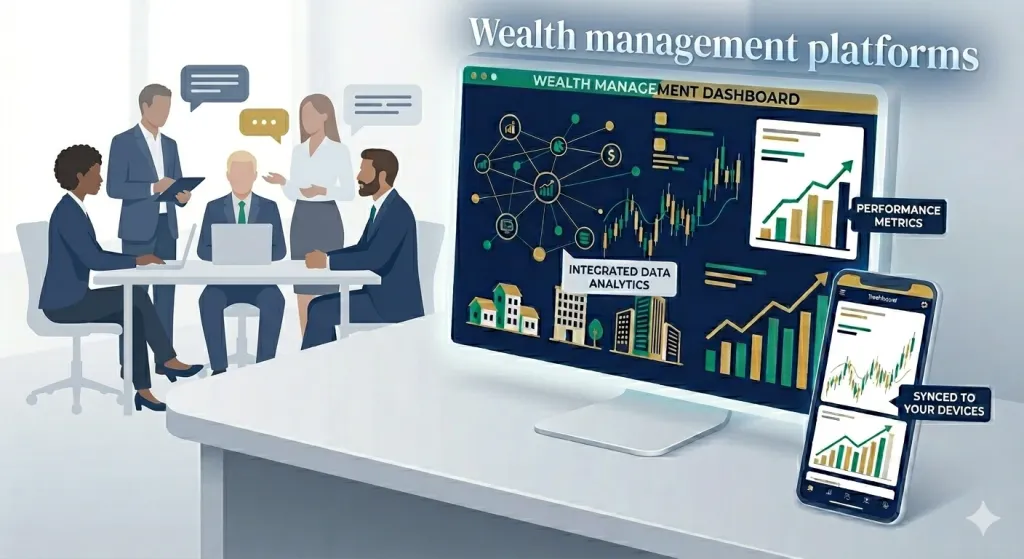
The way people manage wealth has fundamentally changed. Gone are the days when managing significant assets meant endless spreadsheets, quarterly paper statements, and relying entirely on a single advisor’s phone number. Today, wealth management platforms have revolutionized how individuals, families, and financial professionals monitor, grow, and protect assets.
But with dozens of platforms available—from robo-advisors for beginners to enterprise-grade systems for family offices—how do you choose the right one?
Whether you’re an individual investor just starting out, a high-net-worth individual with complex holdings, or a financial advisor serving hundreds of clients, this guide will walk you through everything you need to know about modern wealth management platforms.
What Is a Wealth Management Platform?
A wealth management platform is digital technology that centralizes financial operations into a single system. It connects advisors, clients, and back‑office teams through one source of truth, eliminating the need to jump between disconnected tools for onboarding, reporting, and communication.
Think of it as an operating system for your financial life. Your bank handles the ledger, your custodian holds the assets, and the wealth management platform orchestrates the entire client experience—from digital account opening and automated KYC to real‑time portfolio views and compliance checks.
For individual investors, these platforms provide consolidated dashboards that show total net worth across all accounts, automate rebalancing, and often include tax‑efficient strategies like tax‑loss harvesting. For advisors, they deliver portfolio management tools, client relationship management (CRM), billing, and reporting—all integrated.
Who Needs a Wealth Management Platform?
Wealth management platforms serve three primary audiences, each with different needs:
For Individuals & Retail Investors
If you have investment accounts across multiple brokerages, a 401(k), a savings account, and perhaps some crypto or real estate, a wealth management app helps you see everything in one place. Apps like Empower (formerly Personal Capital) and Fidelity Full View provide free dashboards that aggregate your entire financial picture.
Robo-advisors like Wealthfront, Betterment, and Acorns take it a step further by automatically managing your investments based on your goals and risk tolerance. These platforms charge between 0.25% and 0.50% of assets under management annually—significantly less than traditional human advisors.
For High‑Net‑Worth Individuals (HNWIs) & Family Offices
Once your net worth exceeds 1million(andespeciallyabove15 million), the complexity increases dramatically. You may own multiple properties, have trust structures, hold private equity or venture capital stakes, and need cross-border tax planning.
Platforms like Addepar, Masttro, and Aleta are purpose‑built for this segment. They aggregate financial data across public and private markets, handle complex family office portfolios, and provide military‑grade encryption for multi‑jurisdictional holdings. Eton Solutions recently launched EtonAlpha™ specifically for individuals with $15 million or more in assets, offering billionaire‑grade technology that centralizes everything from fine art collections to real estate holdings into a single, daily‑reconciled dashboard.
For Financial Advisors & RIAs
Registered Investment Advisors (RIAs) and wealth management firms use platforms to scale their practices. Solutions like Envestnet, Betterment Advisor Solutions, and SS&C Black Diamond combine custody, portfolio management, reporting, compliance, and client portals into unified systems. The top‑rated platforms in 2026, according to Defaqto’s service ratings, include Fundment, Quilter, Parmenion, Transact, and Wealthtime.
Core Features of Modern Wealth Management Platforms
A truly comprehensive wealth management platform covers every stage of the client lifecycle:
Consolidated Dashboards & Portfolio Reporting
Your clients expect to see their total net worth in one place, updated in real time—not a PDF that’s two weeks old. A digital platform pulls data from internal systems and external custodians, giving both you and your client an accurate, instant view of financial health.
Digital Onboarding & KYC/AML Compliance
Automated account opening with integrated identity verification and risk profiling speeds up the client acquisition process while ensuring regulatory compliance. Modern platforms handle investor accreditation checks, source of wealth verification, and document collection seamlessly.
Automated Portfolio Rebalancing & Tax Management
One of the most valuable features for investors, automated rebalancing maintains target asset allocations without manual intervention. Advanced platforms incorporate tax‑loss harvesting—selling losing positions to offset capital gains—and direct indexing, which is especially valuable for high‑net‑worth clients.
Alternative Investments Support
Wealthy individuals increasingly allocate to private equity, private credit, real estate, and infrastructure. Modern platforms now provide end‑to‑end support for the entire alternative investment lifecycle, from pre‑investment discovery through subscriptions to post‑investment operations.
Compliance & Risk Management Tools
For advisors, built‑in compliance automation is non‑negotiable. The platform automatically logs client communications, monitors for regulatory issues, and generates audit trails. This significantly reduces operational risk and ensures adherence to fiduciary standards.
Client Communication & Secure Messaging
Clients expect to communicate with their advisors through their preferred channels—secure messaging, video calls, or even WhatsApp. Top platforms integrate omnichannel communication with automatic logging for compliance purposes.
Wealth Management Platform vs. Robo‑Advisor: What’s the Difference?
A common point of confusion: Is a robo‑advisor the same as a wealth management platform?
Not exactly. Here’s a breakdown:
| Feature | Robo‑Advisor | Wealth Management Platform |
|---|---|---|
| Typical Fee | 0.25%–0.50% of AUM annually | 0.75%–1.50% for human advisors; digital platforms vary |
| Service Scope | Primarily investment management | Holistic: tax, estate, retirement, insurance, business planning |
| Human Access | Limited or optional (phone/chat) | Dedicated advisor or team |
| Best For | Beginner to intermediate investors, smaller portfolios | High‑net‑worth individuals, complex financial situations |
| Key Features | Automated rebalancing, tax‑loss harvesting, goal tracking | Full financial planning, alternative investments, generational planning |
Robo‑advisors occupy a middle ground between a DIY trading platform and a full‑service wealth manager. As of 2024, the median robo‑advisor fee was about 0.25%, while human advisors typically charge around 1.0% annually.
However, robo‑advisors only handle investing. Wealth managers provide comprehensive guidance on budgeting, insurance, tax planning, estate planning, and retirement strategies—services that technology alone cannot fully replicate.
2026 Trends Shaping Wealth Management Platforms
The wealth management platform market was valued at 5.06billionin2025andisprojectedtoreach9.6 billion by 2030, growing at a CAGR of 13.7%. Several key trends are driving this growth:
AI as Core Infrastructure
Artificial intelligence is moving from a novelty to a core utility. In 2026, expect widespread adoption of AI for automated compliance monitoring, predictive cash flow analysis, and hyper‑personalized investment proposals—all designed to enhance advisor efficiency while reducing operational risk.
Cloud‑Native Architecture
Cloud infrastructure is no longer just an option—it is the backbone of next‑generation wealth management. Cloud‑native platforms enable better scalability, real‑time market data, automated rebalancing, and personalized client experiences across every device.
Connected Ecosystems via Open APIs
The rigid choice between monolithic suites and fragmented point solutions is giving way to connected ecosystems. Through secure APIs, firms can connect portfolio management systems, custodians, trading venues, fintech apps, tax software, and client portals into a seamless whole.
Rise of Alternative Investments
Wealth managers, family offices, and HNW investors are increasing allocations to alternatives for greater diversification, inflation hedging, and higher returns. The technology landscape is evolving to make alternative investments more accessible, efficient, and customizable, with end‑to‑end platforms handling the entire investment lifecycle.
How to Choose the Right Wealth Management Platform
Selecting a platform depends on your specific situation. Here’s a decision framework:
For Individual Investors
- Portfolio size under $100,000: Start with a robo‑advisor like Wealthfront or Betterment. Low fees (0.25%) and automated management make them ideal for beginners.
- Portfolio 100,000–100,000–1 million: Look for a digital wealth platform that offers access to human advisors. Betterment Premium (0.40% fee) provides unlimited access to Certified Financial Planners after $100,000.
- Portfolio over $1 million: Consider a comprehensive wealth management platform with dedicated advisors, tax optimization, estate planning, and alternative investment access. Compare fees (typically 0.75%–1.50%) against the value of holistic planning.
For Financial Advisors & RIAs
- Small practice (under $100M AUM): Betterment Advisor Solutions offers an all‑in‑one custodial platform with automated back‑office and portfolio management.
- Mid‑size practice (100M–100M–1B AUM): Envestnet provides a fully configurable suite of wealth technology including planning, trading, reporting, proposal generation, CRM, client portal, and billing.
- Large enterprise (over $1B AUM): Addepar, Masttro, or Aleta for complex family office portfolios, multi‑jurisdictional holdings, and private market data aggregation.
Final Thoughts
Wealth management platforms have democratized access to sophisticated financial tools that were once reserved for billionaires. Whether you’re just starting your investment journey or managing a multi‑generational family fortune, there’s a platform designed for your needs.
For investors, the key is matching platform capabilities to your net worth, complexity, and preference for human guidance. For advisors, the platform you choose will shape your firm’s efficiency, compliance, and client experience for years to come.
The wealth management industry is at an inflection point. Those who embrace modern digital platforms—with their AI‑driven insights, open APIs, and cloud‑native scalability—will thrive. Those who cling to legacy systems will find themselves left behind.
Read More
Retirement Investment Strategies 2026: A Complete Guide to Building Wealth That Lasts
Stock Trading Apps 2026: The Complete Guide to Mobile Investing